
On Old Hat

As we near the mountaintop, it's time to turn around and see how far we've come. The march of progress leaves behind many footsteps.
I thought it'd be cool to show you guys some of the old card ideas that have come and gone. These have each made it to different stages of development; I'll go in chronological order, so the first few have no art. I'm looking at the version history on a Google doc titled "PILES". Yeah, well, it's a game with four piles. Sue me. This is back when the characters were the King, the Fool, and the Vicar. Let's see:
DIVINE INTERVENTION [Vicar, Keep]: If this card is in your keep, you may take one extra action in-between any two player actions, then discard this card.
I like how well the name here is tied to the effect, but it adds too much mental overhead. These "interrupt" cards slag the game down with delay, as people pause after every action to make sure Divine Intervention won't take place, and have to add every possibility to their search tree. Too bloated, too inelegant. This card was reworked into Hocus Pocus, which lets you take a surprise extra action on your turn.
ABRACADABRA [Fool, Keep]: If this card is in your keep when another player plays a card, you can say "Alakazam" to negate its effects. Then, discard this card.
Many people ask me why I don't have a "NOPE!" card like this, which one-time nullifies a card. Most importantly, it is not defined well enough, leading to people playing their cards and effects quickly, hoping to outspeed the noper. The "Alakazam" gimmick was meant to counteract that, but it still invited too much inelegant strife and mechanical ambiguity. It also has the same interrupt problems that Divine Intervention did.
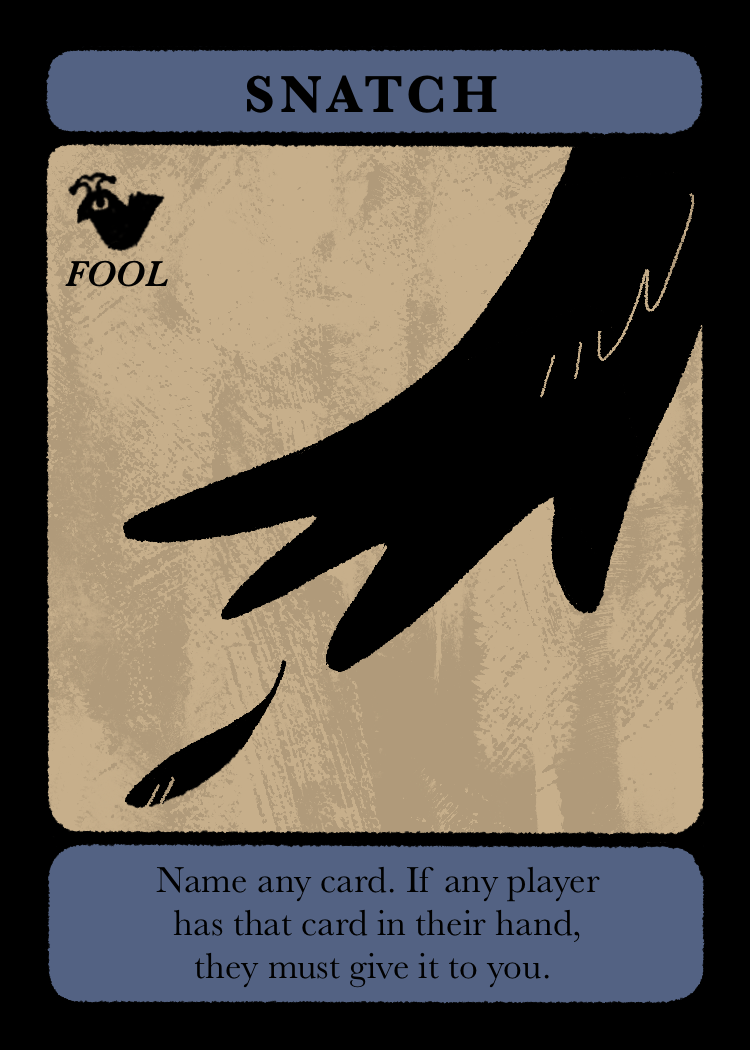
The biggest problem here is that a newer player might not yet know the 36 cards, so it would be useless to them, and if no player has the named card, it would be useless anyway. Snatch laid the groundwork for what became Pluck: Look at everyone's hand and choose one card to steal. Now new players can use it, it never fails, and it is more strategic as it gives information.

Penance is a good example of a card that is almost perfect. There is nothing wrong with it; it just wasn't weighty enough. It generally turns into a slightly more strategic "skip your turn" card. Penance became Shackles (a Fool card) which does the same thing, but carries -3 coins. This allows it to synergize with Duplicity, Purity, Interest, etc., and makes it more important.

Confession has the honor of having my favorite artwork of any card. Elaina and I died a little inside when we realized we had to cut it. The problem is simply that it is too weak: the information is wonderful, but the card mechanically does nothing. The workaround was simple when Pluck was added, as it does this and more. Rest in peace, Confession.
So that's all the ideas I want to share today. There are indeed many more, nearly fifty, but they are silly, similar, or insignificant.
I want to emphasize that some of these ideas were not bad. Many were even quite good. But to make the final cut for the Keeps deck, "quite good" was not enough. They had to be perfect. They had to have a personality, strong synergies, add their own strategy and flair, have fun reactions in testing, and feel good to play. So if my reasons for rejection seem small, take it as evidence that the official 36 Keeps cards had no reasons at all!
It was a nice break, and it had a spectacular view, but the journey is not over. There are always more mountains.
-David


Comments